Building material suppliers play an important role in construction projects where several products need to work together. Tile trims, adhesives, grout and floor drains each have specific requirements, and selecting them independently can lead to fitting issues during installation. A product may meet its individual specifications but still be unsuitable for the complete installation.
For contractors, procurement teams and interior designers, the priority is to find products that meet the project’s technical and design requirements. Checking dimensions, application conditions and installation details before ordering can help reduce material waste, avoid unnecessary replacements and keep work on schedule.
This guide explains how to assess compatibility across common tiling and finishing products, what documentation to review and how to compare potential suppliers before making a purchasing decision.
Contents
- 1. 4 Essential Compatibility Checks for Bathroom Installation Materials
- 2. Matching Tile Trims to Tile Thickness and Finish
- 3. Selecting Tile Adhesives for Bathroom Wall and Floor Surfaces
- 4. Choosing Grout for Consistent Tiling Results
- 5. Coordinating Floor Drains With Tile Layouts
- 6. Building Material Suppliers: A Practical Procurement Checklist
- 7. Conclusion
- 8. Frequently Asked Questions
4 Essential Compatibility Checks for Bathroom Installation Materials
Before placing an order, buyers should review how each product will interact with the surrounding materials. This is particularly important when different components need to fit within the same floor or wall detail.
The following checks provide a practical starting point:
- Dimensions: Compare tile thickness, profile height and finished floor levels.
- Application requirements: Confirm that each product suits the intended surface and installation conditions.
- Technical specifications: Review product data sheets and manufacturer instructions.
- Installation sequence: Identify components that must be positioned or fitted in a particular order.
Completing these checks before purchasing helps teams identify missing information while there is still time to resolve it. It also makes discussions with potential suppliers more productive because the project requirements are clearly defined.
Matching Tile Trims to Tile Thickness and Finish
Choose the Right Profile for the Application
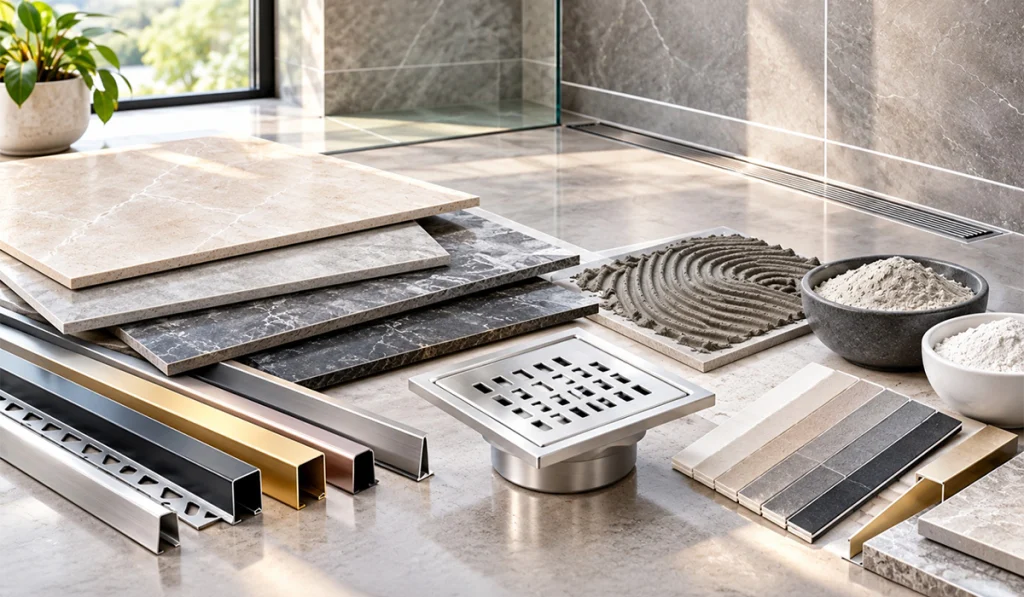
Tile trim manufacturers offer profiles in different shapes, materials, finishes and dimensions. The right choice depends on tile thickness, adhesive depth and the location of the exposed edge. A profile that is too shallow may leave the tile edge exposed, while an unsuitable shape can create an uneven transition between surfaces.
For example, an external tiled corner may need a different profile from a junction between two flooring materials. Buyers should compare the proposed profile with an actual tile sample and check the relevant installation details before confirming the specification.
What Should Buyers Check?
- Profile height: Ensure the profile accommodates the tile and adhesive arrangement.
- Material: Consider moisture exposure, cleaning requirements and the intended application.
- Edge design: Check whether the profile suits corners, exposed edges or floor transitions.
- Finish: Compare the colour and surface appearance with the tile and surrounding fixtures.
Physical samples are useful when several finishes are under consideration. They allow the project team to assess the appearance in context and verify the dimensions before ordering the required quantity.
Selecting Tile Adhesives for Bathroom Wall and Floor Surfaces
Check Bonding Requirements Before Ordering
When comparing products from a tile glue manufacturer UAE, buyers should focus on documented applications rather than price or general product descriptions. Porcelain tiles, large-format tiles and different substrates may require specific adhesive properties.
The adhesive must suit the selected tile, the supporting surface and the installation environment. A product intended for one application may not be appropriate for another, so its technical specifications should be checked against the project requirements.
Essential Adhesive Checks
- Tile compatibility: Confirm that the adhesive is recommended for the selected tile type and format.
- Substrate preparation: Check whether priming, levelling or other preparation is required.
- Application conditions: Review mixing instructions, working time and recommended application thickness.
- Environmental suitability: Verify its intended use in wet areas or exterior installations, where applicable.
Quantity estimation also matters. Coverage varies according to the substrate, trowel size and application method, so use the manufacturer’s guidance to calculate requirements. This helps reduce shortages and unnecessary leftover material.
Choosing Grout for Consistent Tiling Results
Match the Product to the Joint Requirements
When comparing options from a tile grout manufacturer UAE, buyers should check whether the product suits the specified joint width, tile surface and expected exposure. These factors are more useful for selection than colour alone.
Grout also affects the overall appearance of a tiled surface. A contrasting shade highlights the joint pattern, while a complementary colour creates a more uniform finish. Reviewing physical samples alongside the selected tiles helps buyers assess the combination under suitable lighting.
Checks Before Confirming the Grout
- Joint width: Verify that the product supports the specified joint dimensions.
- Colour consistency: Compare samples with the actual tile rather than relying only on digital images.
- Cleaning requirements: Review the recommended cleaning method, particularly for textured tiles.
- Application instructions: Follow the manufacturer’s guidance on mixing, application and curing.
For projects completed in phases, buyers should plan quantities carefully and check batch information where relevant. Consistent product selection across installation stages helps maintain a uniform finish between adjoining areas.
Coordinating Floor Drains With Tile Layouts
Confirm Dimensions and Drainage Requirements
When exploring floor drains UAE, buyers should consider technical suitability alongside appearance. The selected drain must fit the planned floor construction, connect correctly to the drainage system and work with the intended tile layout.
Linear and point drains can require different cutting arrangements and positioning. Their locations must also align with the floor gradient and finished surface level. Reviewing these details before finalising the tile layout helps prevent conflicts during installation.
What Needs to Be Verified?
- Outlet connection: Check compatibility with the specified pipework.
- Installation depth: Confirm that the drain suits the planned floor build-up.
- Floor gradient: Ensure the design directs water towards the drainage point.
- Maintenance access: Consider how removable covers and strainers will be cleaned.
The waterproofing detail should be reviewed at the same stage. The drain assembly and surrounding waterproofing system must follow the approved installation requirements, with any technical uncertainties resolved before work begins.
Building Material Suppliers: A Practical Procurement Checklist
Review Product Information Together
A building material supplier in UAE can be evaluated more effectively when buyers have a clear list of project requirements. When comparing the existing products with this list, it becomes easier to determine which are appropriate and find missing technical data prior to placing an order.
Use this checklist during procurement:
- Compare tile thickness with the selected trim dimensions.
- Verify adhesive suitability for the tile and substrate.
- Confirm that grout meets the specified joint requirements.
- Check drain dimensions, outlet connections and installation depth.
- Review relevant technical data sheets and installation instructions.
- Confirm quantities, availability and delivery schedules.
- Resolve specification differences before approving substitutions.
This is beneficial for the procurement team, the designer and the installing professional to be able to refer to one schedule. This is helpful in cases where there is specification change or purchase of materials at different stages.
Handle Substitutions With Care
If a specified product becomes unavailable, an alternative should not be approved solely because it looks similar or costs less. Differences in dimensions, application requirements or installation methods can affect other components in the same system.
Compare the proposed alternative with the initial specification and identify any differences. Seek approval from the relevant project professional when necessary before agreeing to the change. This will help avoid the situation where the purchase decision leads to more work during installation.
Conclusion
Building material suppliers are an important consideration when tile trims, adhesives, grout and drainage components must work together. Dimensional check prior to ordering helps eliminate issues with compatibility. It is essential to check the technical requirements and installation requirements before placing orders for particular products. It will help in making an informed decision about buying products.
For businesses looking to explore relevant providers and services, Aesell offers a platform to discover businesses and simplify the search process.
Frequently Asked Questions
How can buyers check product compatibility when choosing building material suppliers?
Check the technical data sheets, sizes and applications of the products, then compare them to the drawings for the project and installation requirements. Clarify any doubts before making the order.
Why should product samples be reviewed before purchasing?
Samples give the buyer an opportunity to compare actual sizes, colors, textures, and finishes. They can show differences that cannot be seen from catalog photos or product descriptions found online.
What should buyers check before approving a product substitution?
Compare the dimensions, technical specifications, usage, and suitability of the alternative to the existing surroundings. Get the required technical and project approvals before replacing.